For years, the conversation around electric vehicles has been dominated by two major concerns: how far can you drive, and how long does it take to charge? If you have ever owned or even just rented an electric vehicle, you know exactly what I am talking about. Range anxiety is a real psychological hurdle, and the prospect of waiting an hour at a public charging station on a cold night is not appealing to anyone.
However, the landscape of electric mobility is shifting at an incredibly rapid pace. Recently, the automotive world has been buzzing about a completely new ev battery developed by BYD. Promising a staggering 625-mile range and the ability to Charge in Minutes, this development feels like a massive leap forward. But what does this actually mean for everyday drivers? Let’s break down the technology, the practical implications, and the potential hurdles that come with this kind of breakthrough.
Understanding the Evolution of the EV Battery
To appreciate why a 625-mile range is such a big deal, we need to look at where we started. Early electric cars often struggled to hit the 100-mile mark. They were perfect for short city commutes but entirely impractical for cross-country road trips. Over the last decade, advancements in lithium-ion technology, and specifically Lithium Iron Phosphate (LFP) chemistry, have steadily pushed those numbers up.
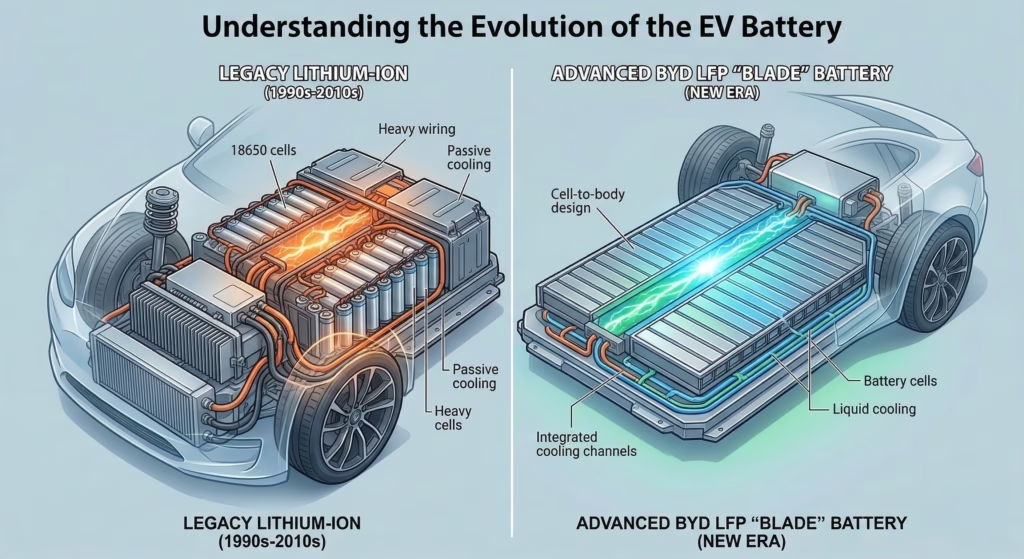
A standard ev battery today typically offers anywhere from 200 to 350 miles of range. For most daily commutes, this is more than enough. But the modern driver is looking for parity with internal combustion engines. We are used to filling up a gas tank and driving 400 or 500 miles without a second thought.
The introduction of a BYD battery capable of crossing the 600-mile threshold fundamentally changes the math. From practical experience, a range of this magnitude means that the average driver might only need to charge their vehicle once every two weeks. For long road trips, it completely eliminates the need to meticulously plan your route around charging stops.
The Reality of a 625-Mile Range
When we hear a number like 625 miles, it is important to contextualize it. In the automotive industry, range is tested under specific laboratory conditions. Depending on whether the testing standard is WLTP (used widely in Europe), EPA (used in the US), or CLTC (used in China), the real-world numbers can vary significantly.
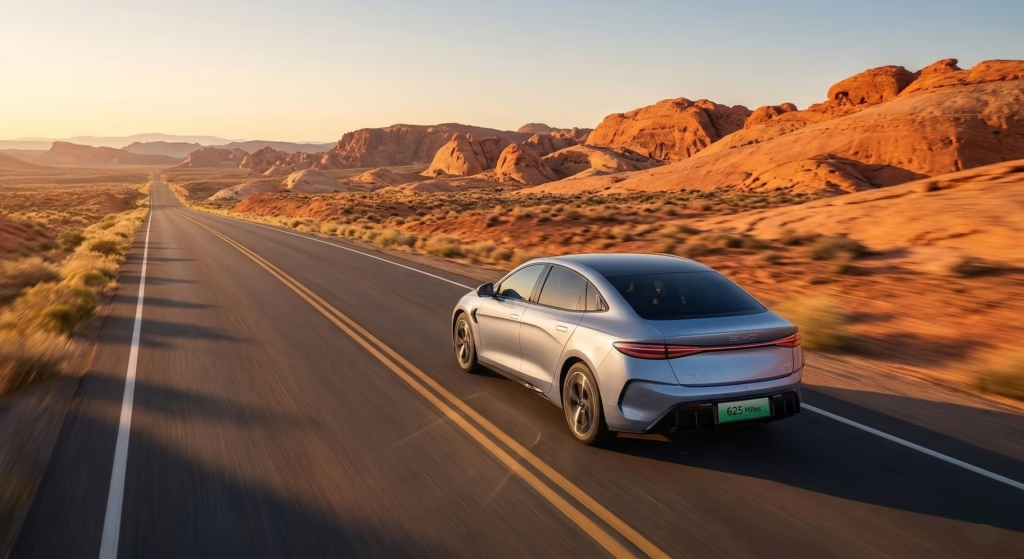
In real-world use, an EV’s range is affected by several factors:
- Highway Speeds: Driving at 75 mph drains a battery much faster than driving at 45 mph in city traffic, largely due to wind resistance.
- Weather Conditions: Extreme cold can reduce an EV’s efficiency because the battery needs to expend energy just to keep itself warm, and running the cabin heater drains extra power.
- Driving Habits: Aggressive acceleration and heavy braking will reduce your overall mileage.
Even if a 625-mile rated battery delivers a true, real-world range of 500 miles on a freezing winter highway, that is still a phenomenal achievement. It provides a massive buffer that completely neutralizes range anxiety. It means you can drive from Los Angeles to San Francisco, or from London to Edinburgh, on a single charge with miles to spare.
The Holy Grail: How Is It Possible to Charge in Minutes?
While the extended range is impressive, the charging speed is arguably the more disruptive innovation. Historically, fast-charging a large battery introduces a major enemy: heat. Pushing massive amounts of electricity into a confined space generates extreme temperatures, which can severely degrade the battery cells over time.
So, how does a manufacturer get a battery to Charge in Minutes without causing long-term damage?
It comes down to an intricate dance of battery chemistry, advanced thermal management systems, and internal architecture. Modern high-tech batteries are being designed with improved internal resistance. Lower resistance means less heat is generated during the charging process. Furthermore, automotive engineers are utilizing sophisticated liquid cooling systems that actively manage the temperature of individual battery cells while they are hooked up to a high-voltage charger.
When you can pull into a station, plug in, and get hundreds of miles of range in the time it takes to grab a coffee and stretch your legs, the EV experience becomes indistinguishable from visiting a traditional gas station. Many users notice that the charging time is the biggest bottleneck in EV adoption; removing this friction point is a game-changer.
What This Means for Future BYD Cars
BYD has rapidly grown from a battery manufacturer into one of the world’s most formidable automotive brands. Their deep understanding of energy storage gives them a unique vertical integration advantage. Because they design both the cells and the vehicles, they can integrate the battery directly into the chassis of the car—a method often referred to as cell-to-body or cell-to-chassis architecture.
When this new ev battery makes its way into future byd cars, we can expect a few structural benefits:
- Increased Cabin Space: Better energy density means the battery packs can hold more power without necessarily taking up more physical space, allowing for roomier interiors.
- Structural Rigidity: Integrating the battery directly into the frame of the car improves safety and handling.
- Cost Efficiency: While new technology is always expensive at first, BYD’s massive manufacturing scale historically allows them to bring costs down faster than many competitors.
If byd cars begin hitting global markets equipped with this technology at an accessible price point, it will force the rest of the industry—from legacy automakers to prominent EV startups—to accelerate their own battery research and development.
The Catch: Challenges and Real-World Limitations
As an experienced observer of automotive technology, I always look for the “catch” when revolutionary numbers are announced. While the technology itself is incredibly promising, there are external and practical hurdles that the industry must overcome to fully utilize it.
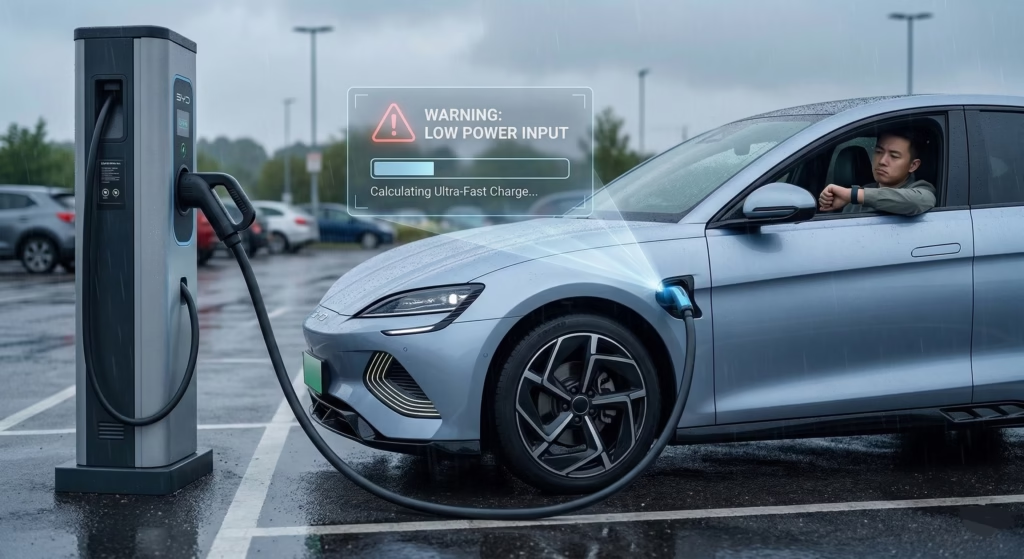
1. The Infrastructure Bottleneck
You can have a battery that accepts a charge in five or ten minutes, but if the charging station cannot deliver that level of power, the feature is useless. To charge a massive battery that quickly requires ultra-fast, high-voltage DC chargers (often 350kW to 500kW or more). Right now, the global charging infrastructure is heavily populated with slower 50kW to 150kW chargers. Upgrading the electrical grid and installing these massive power stations is a multi-billion-dollar, multi-year project.
2. Weight and Efficiency
Batteries are heavy. While energy density (the amount of power a battery holds relative to its weight) is improving, a battery pack capable of delivering 625 miles is likely going to add significant mass to the vehicle. Heavier cars wear through tires faster, require more robust braking systems, and are inherently less efficient. The engineering challenge is finding the perfect balance between giving the consumer the range they want and keeping the vehicle light enough to be agile and efficient.
3. Cost to the Consumer
Groundbreaking technology rarely comes cheap. The materials, research, and manufacturing processes required to build advanced, highly durable, fast-charging batteries add up. Initially, we can expect this kind of performance to be locked behind the highest trim levels of luxury or flagship vehicles. It will take time for the economies of scale to bring this tech down to the budget-friendly commuter cars.
Final Thoughts: A Paradigm Shift in Mobility
We are standing at a fascinating intersection of chemistry, engineering, and consumer demand. The development of a high-capacity BYD battery that can virtually eliminate charging wait times is a clear signal of where the industry is heading.
From a practical standpoint, this is exactly what the average consumer has been waiting for. People do not want to change their driving habits to accommodate their cars; they want their cars to accommodate their lives. The ability to drive over 600 miles and recharge in the blink of an eye brings us closer to a future where electric vehicles are not just an alternative to gas-powered cars, but the undisputed superior choice.
While it may take a few years for the public charging infrastructure to catch up to the capabilities of this new ev battery, the groundwork is firmly being laid. As these advancements roll out into production models, the transition to electric mobility will likely see a massive surge in momentum. The era of range anxiety is slowly but surely coming to an end.