Whenever we look up at the night sky, the inevitable question arises: where do we go next? For decades, the debate over humanity’s next home has dominated the scientific community. When it comes to living Moon vs Mars, everyone seems to have a favorite. Some argue that our closest celestial neighbor is the only logical first step, while others believe the Red Planet offers the most realistic long-term chance for a self-sustaining human civilization.
As someone who has spent years analyzing space mission logistics and planetary science, I can tell you that stepping away from the science fiction hype is crucial. To really understand what it takes to build a colony off-world, we have to look at the cold, hard facts of physics, human biology, and real-world engineering. Living in space isn’t just about planting a flag; it’s about surviving the daily grind in an environment that actively wants to kill you.
Let’s break down the practical realities, challenges, and step-by-step logic of living Moon vs Mars.
Why the Debate Between Living Moon vs Mars Matters Today
From a practical standpoint, choosing between the Moon and Mars isn’t about picking a winner and forgetting the loser. Space agencies don’t view this as a competition, but rather as a sequence of technological stepping stones. However, resources on Earth are finite. Building rockets, designing life-support systems, and funding these massive endeavors requires strict prioritization.
In real-world mission planning, every kilogram of cargo matters. If we focus entirely on Mars, we risk facing challenges millions of miles away with no safety net. If we focus only on the Moon, we might build incredible outposts but fail to ever push humanity to become a truly multi-planetary species. Understanding the unique quirks of each destination helps us figure out the safest, most efficient roadmap for the future.
The Daily Realities of Living on the Moon
The Moon is right in our cosmic backyard. Because of this, it is overwhelmingly favored as the primary testing ground for extraterrestrial living. But proximity doesn’t mean it’s an easy place to set up camp.
The Ultimate Safety Net: Proximity to Earth
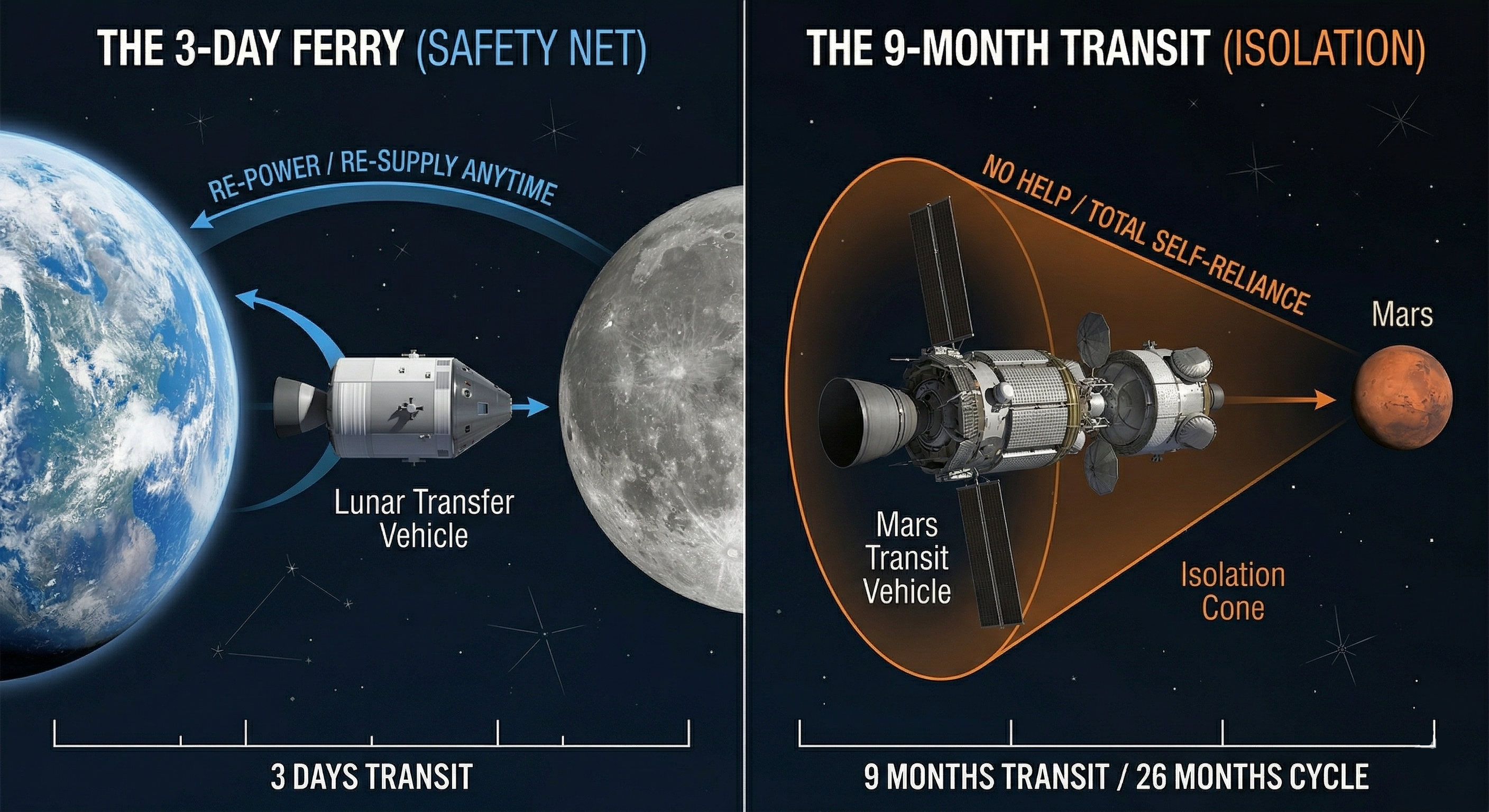
When comparing living Moon vs Mars, the most massive difference is the commute. Traveling to the Moon takes about three days. From practical experience in disaster management and mission control, a three-day journey means you have a viable safety net.
If a life-support system fails, or if an astronaut requires emergency medical evacuation, a three-day return trip is manageable. Furthermore, sending replacement parts, fresh food, or new crew members can be done on a regular, predictable schedule. You don’t have to wait for the planets to align to launch a rescue mission.
Gravity and the Human Body
One of the hardest things for the human body to endure in space is the lack of gravity. On the Moon, gravity is about one-sixth (16.5%) of what we feel on Earth. Many experts notice that while this low gravity is incredibly fun for bounding across the lunar surface, it presents severe long-term health risks.
In real-world use on the International Space Station, we see that astronauts lose bone density and muscle mass rapidly without Earth’s gravity. Living on the Moon for years at a time would require rigorous, daily exercise routines using specialized resistance equipment. Even then, we simply do not have enough long-term data to know if a child born in one-sixth gravity could ever safely visit Earth.
The Radiation and Dust Problem
The Moon has no atmosphere and no global magnetic field. This means it offers absolutely zero protection against solar flares and galactic cosmic rays. To survive, lunar habitats will likely need to be buried underground, perhaps inside ancient lava tubes, or covered with thick layers of lunar soil (regolith).
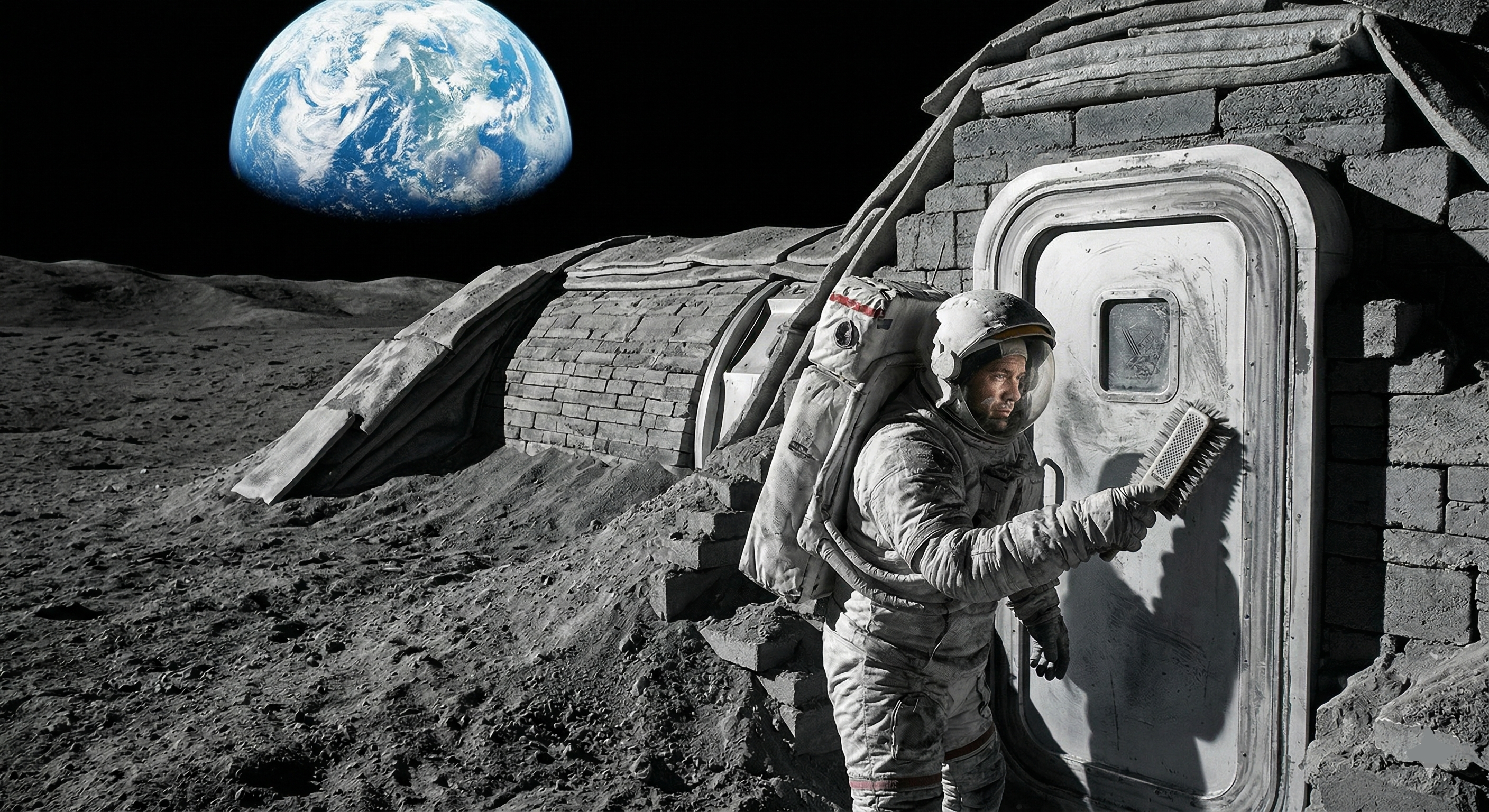
Speaking of regolith, lunar dust is a massive, real-world engineering nightmare. Because there is no wind or water to smooth it out, lunar dust particles are as sharp as broken glass. During the Apollo missions, astronauts noticed that this abrasive dust clung to everything, degrading spacesuit seals and clogging equipment. Managing this dust will be a daily, exhausting chore for lunar colonists.
The Long Game: What Living on Mars Really Looks Like
If the Moon is our testing ground, Mars is the ultimate goal. It is the most Earth-like planet we have access to, but “Earth-like” is a very relative term.
The Daunting Commute and Isolation
Unlike the three-day sprint to the Moon, traveling to Mars takes anywhere from six to nine months, depending on the alignment of the planets. And those launch windows only open up once every 26 months.
When you factor in this distance, the dynamic of living Moon vs Mars completely shifts. Mars colonists will have absolutely no physical safety net. If a critical system breaks, they cannot call Earth for a spare part—they have to manufacture it themselves or fix it with what they have. Communication delays also mean that a simple radio message to Earth can take up to 20 minutes to arrive, making real-time conversations impossible.
A More Earth-Like Day
One surprising advantage Mars has over the Moon is its day-night cycle. A day on Mars (called a “sol”) is 24 hours and 39 minutes. From a biological standpoint, this is a massive win. The human circadian rhythm operates naturally on a roughly 24-hour cycle.
On the Moon, a single “day” of sunlight lasts for 14 Earth days, followed by 14 days of freezing darkness. Mars colonists will experience a normal rhythm of sleeping at night and working during the day, which psychologists and doctors agree is vital for long-term mental health.
Harnessing Martian Resources
If humanity is going to survive on Mars, we have to live off the land. This concept is called In-Situ Resource Utilization (ISRU). Mars has a thin atmosphere made mostly of carbon dioxide, and we have confirmed the presence of water ice at the poles and beneath the surface.
Through a chemical reaction known as the Sabatier process, engineers can combine carbon dioxide from the Martian air with hydrogen (split from Martian water ice) to create methane and oxygen. This means a Mars colony can theoretically produce its own rocket fuel, breathable air, and drinking water. While the Moon has water ice hidden in deep craters, Mars offers a more globally distributed set of raw materials for a self-sustaining civilization.
Head-to-Head: Which is Actually More Feasible?
When we look at the logistics step-by-step, comparing living Moon vs Mars boils down to a question of timing versus potential.
Energy and Power Reliability
Power is life in space. On the Moon, if we set up a base at the lunar South Pole, we can take advantage of peaks of eternal light—areas that receive near-constant sunlight for solar panels.
Mars, however, is farther from the sun and receives only about half the sunlight Earth does. Worse, Mars is prone to global dust storms that can block out the sun for weeks or even months at a time. This is exactly what killed NASA’s Opportunity rover. From practical experience, any Mars colony will have to rely heavily on nuclear power (like small modular reactors) because solar power is simply too risky to trust with human lives.
The “Stepping Stone” Strategy
Ultimately, almost every major space agency and aerospace engineer agrees: we cannot realistically colonize Mars until we have successfully colonized the Moon.
The Moon is our sandbox. It is where we will test closed-loop life support systems, refine our spacesuit designs, and figure out how to mine extraterrestrial ice. If a water recycling machine breaks on the Moon, the crew goes home. If it breaks on Mars, the crew perishes. Therefore, the Moon is the most feasible immediate step, while Mars remains the most feasible long-term home.
The Psychological Toll: Far From Home
One aspect of living Moon vs Mars that often gets overlooked in technical discussions is the human mind. Real-world psychology plays a massive role in mission success.
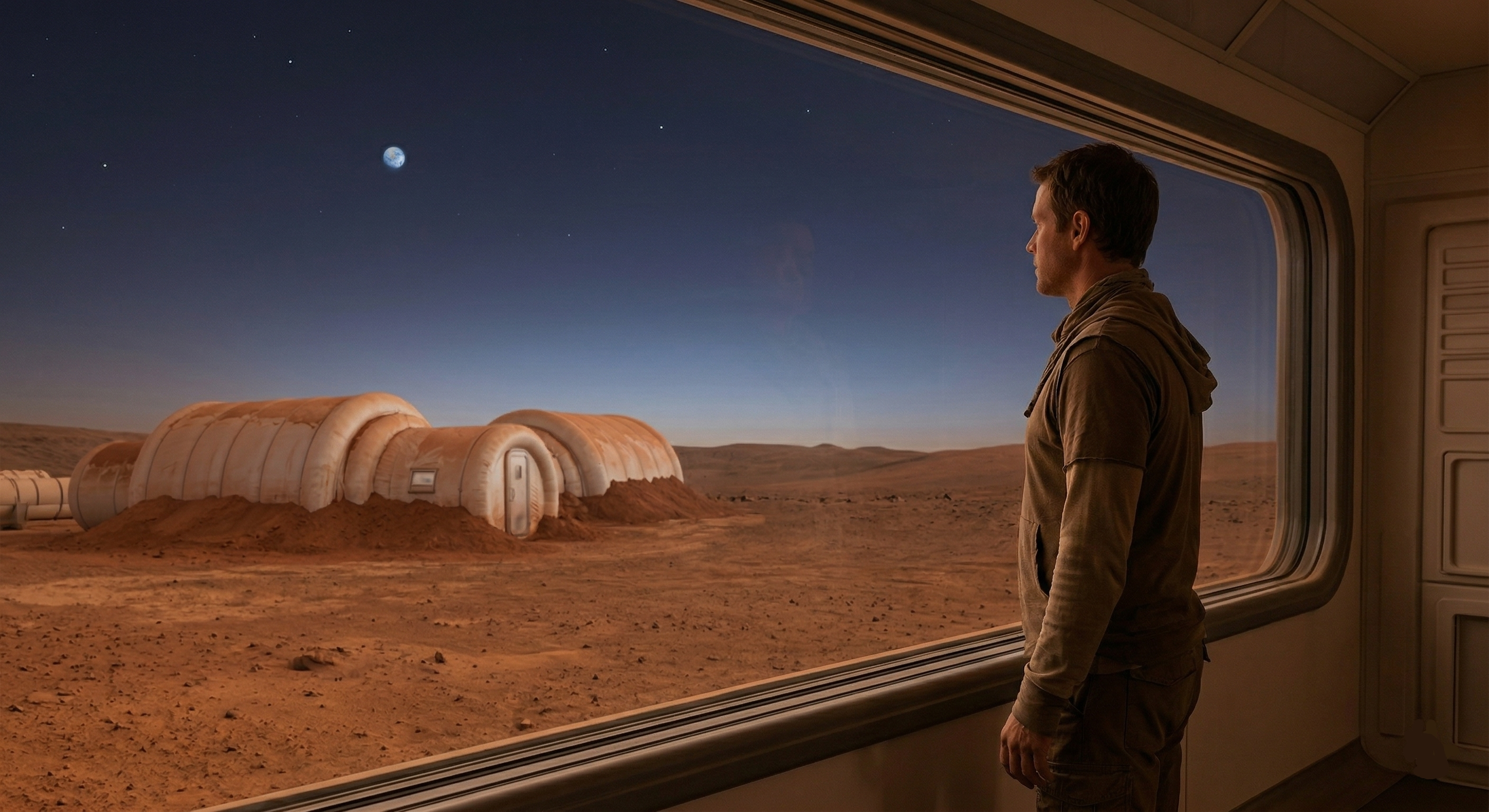
On the Moon, astronauts can look up into the black sky and see a beautiful, blue-and-white marble. They can see Earth. They know home is right there.
On Mars, Earth is nothing more than a pale blue dot—just another star in the sky. The psychological phenomenon known as the “Earth out of view” effect is something researchers are heavily studying. Being completely disconnected from the visual anchor of our home planet, combined with the extreme confinement of a habitat and the inability to simply step outside for a breath of fresh air, will require colonists to have unprecedented mental resilience.
Final Thoughts on Our Future in Space
The debate over living Moon vs Mars isn’t really a question of “which one.” It’s a question of “in what order.”
The Moon offers us a logical, accessible, and relatively safe environment to learn how to be a spacefaring species. It forces us to solve problems regarding low gravity, intense radiation, and resource management while keeping our training wheels on.
Mars, on the other hand, is the ultimate test of human endurance and ingenuity. It offers the raw materials needed for true independence, but demands absolute perfection from the technology and the people who go there.
Whether you are looking at it from an engineering perspective, a biological standpoint, or simply the human desire to explore, both destinations hold the key to our future. The journey will be difficult, incredibly expensive, and fraught with danger, but as history has shown, human beings have never been very good at staying put.