
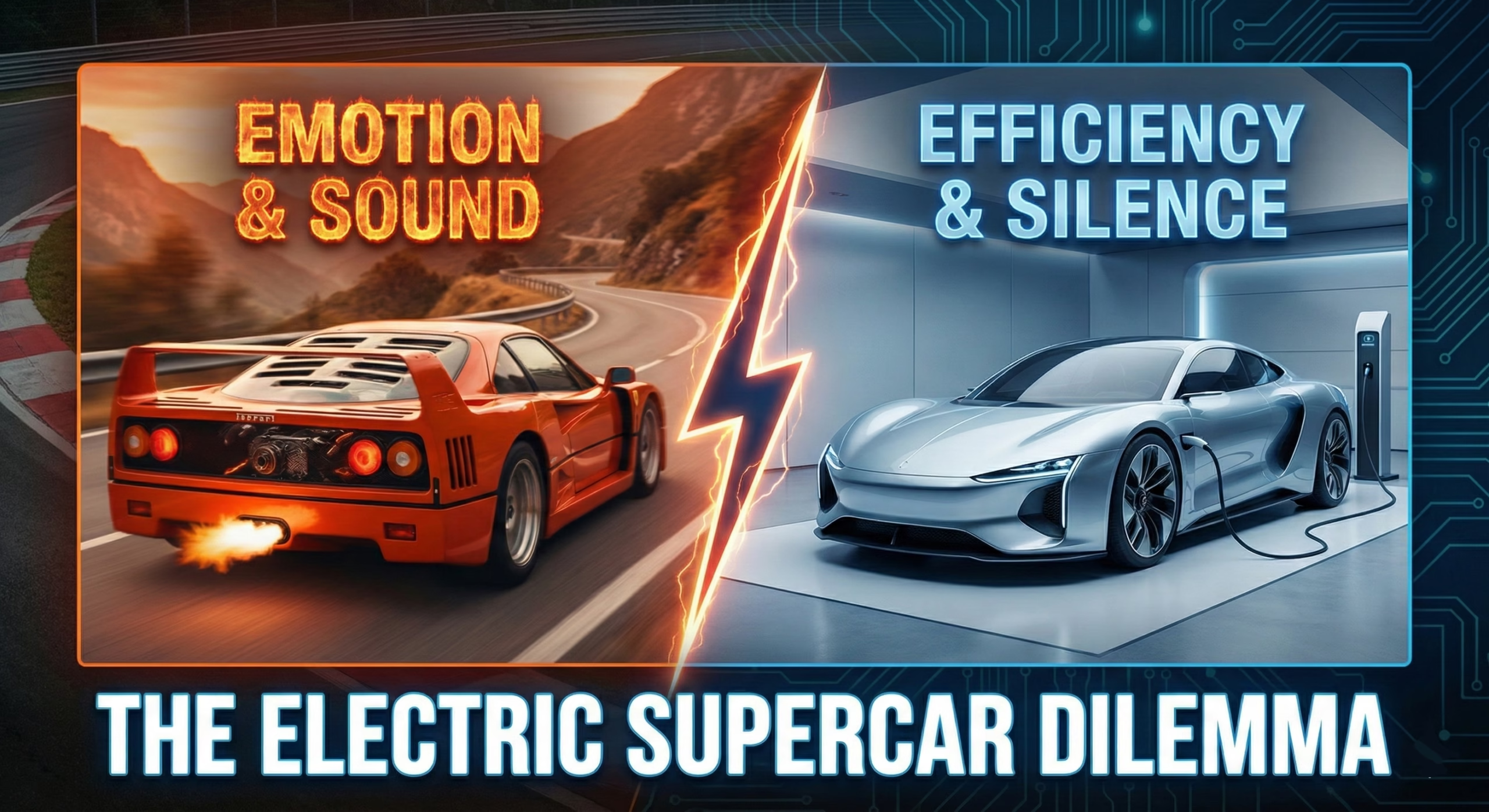

The automotive industry has spent the last decade racing toward a fully electric future. For daily commuters, family SUVs, and city hatchbacks, the transition makes perfect sense. Electric vehicles offer quiet rides, lower daily running costs, and the convenience of waking up to a full battery in your garage. However, when we look at the absolute peak of the automotive world, the narrative changes dramatically.
Recently, major players in the high-performance sector, including iconic brands like Lamborghini, have taken a step back to re-evaluate their strategies. The reality is that the EV market for ultra-high-end performance vehicles is not growing at the same explosive rate as the mainstream sector. In fact, consumer demand in this highly specific niche seems to be flattening out entirely.
To understand why building a battery-powered hypercar is completely different from building an electric family sedan, we have to look closely at consumer psychology, automotive engineering, and the very definition of what makes a vehicle truly special.
The Unique Psychology of High-End Auto Buyers
When a person walks into a dealership to buy a standard commuter car, their checklist is usually quite logical. They want reliability, good mileage, ample trunk space, and safety features. An electric vehicle easily checks all these boxes.

But the market for luxury cars and exotic supercars operates on a completely different wavelength. Buyers spending hundreds of thousands of dollars on a vehicle are not looking for basic transportation. They are buying a piece of functional art. They are purchasing a highly emotional, sensory experience.
The Importance of Auditory and Physical Feedback
From practical experience, enthusiasts buy high-performance vehicles for the drama. A massive part of that drama comes from the internal combustion engine (ICE). The mechanical symphony of a V10 or V12 engine revving up to 8,000 RPMs creates a physical sensation that vibrates through the seats and the steering wheel.
Electric motors are incredibly efficient and astonishingly fast, but they are completely silent. While a quiet, smooth ride is a massive selling point for a luxury sedan meant to isolate the driver from the road, it is a negative trait for a supercar meant to connect the driver to the asphalt. Many users notice that driving a high-horsepower EV feels a bit like playing a video game on mute—the speed is undeniably there, but the visceral thrill and the mechanical connection are missing.
The Problem with the “Acceptance Curve”
Automakers track data obsessively. They look at what their current clients are asking for and what prospective buyers are researching. Right now, the data points to a harsh truth: the target audience for exotic, million-dollar vehicles simply does not want pure battery-electric cars yet.
If an automaker forces an all-electric product onto a consumer base that explicitly wants the theater of a combustion engine, that project risks becoming an incredibly expensive failure. It becomes a vanity project rather than a viable business move. Building a car that no one asked for, especially in a low-volume, high-margin industry, is a massive financial risk that even the most legendary brands are currently unwilling to take.
Engineering Challenges: Why Batteries and Track Days Clash
Beyond consumer psychology, there are very real, physical engineering hurdles that make the marriage of pure electricity and track-focused performance incredibly difficult.
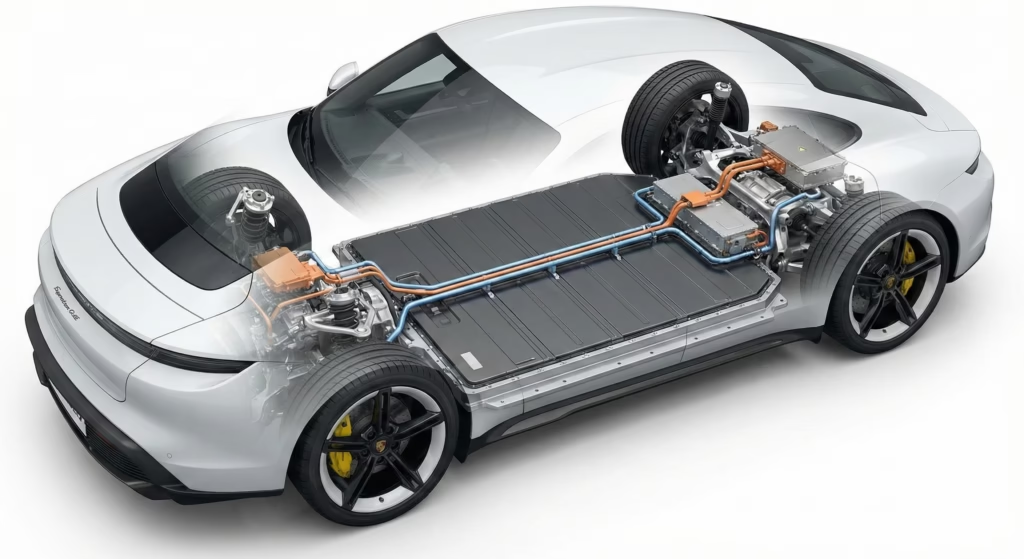
The Weight Penalty of Lithium-Ion
In real-world use, weight is the absolute enemy of automotive performance. A heavier car takes longer to stop, puts more stress on its tires, and struggles to change direction quickly.
Current battery technology, while improving, is still exceptionally heavy. To give an electric supercar enough range to be useful, and enough power to be terrifyingly fast, engineers have to install massive battery packs. This easily adds hundreds of pounds to the vehicle’s curb weight.
While engineers can use clever software and advanced suspension systems to hide this weight in a straight line, physics always wins in the corners. A lightweight, mid-engined gas supercar will naturally feel more agile, nimble, and engaging on a twisting mountain road or a dedicated racetrack than a heavy, floor-battery EV.
Thermal Management and Sustained Performance
Another overlooked factor is heat. When you discharge a battery incredibly fast—which is what happens when you accelerate hard in an EV—the battery and the electric motors generate massive amounts of heat.
If you take a high-performance EV to a racetrack, you might be able to set a blisteringly fast lap time for one or two laps. But very quickly, the car’s computer systems will intervene to protect the battery from overheating, drastically reducing power output. Traditional combustion engines, equipped with massive radiators and cooling systems, can run lap after lap, all day long, without losing significant performance. For the hardcore driving enthusiast, sustained performance is a mandatory requirement.
The Middle Ground: Why Plug-In Hybrids are Winning
If pure electric power isn’t the answer right now, and strict global emissions regulations mean companies can’t just keep building traditional gas-guzzling engines forever, what is the solution? The answer lies in the Plug-in Hybrid Electric Vehicle (PHEV).
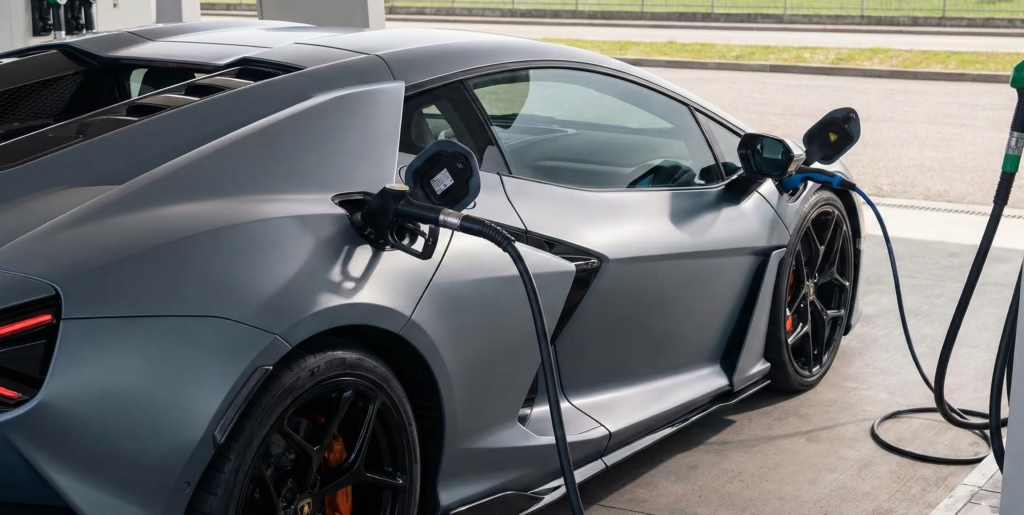
Major luxury and performance brands are aggressively pivoting their research and development budgets toward hybrid technology. This is not a compromise; for many engineers, it represents the ultimate “best of both worlds” scenario.
How Performance Hybrids Work
In a modern performance hybrid, the electric motors are not meant to replace the combustion engine; they are meant to support it.
Internal combustion engines have a natural flaw: they need time to build up RPMs before they deliver their maximum power. This delay is often called lag. Electric motors, on the other hand, deliver 100% of their torque the exact millisecond you press the accelerator pedal.
By pairing a high-revving, emotional gas engine with a smaller, lightweight battery and electric motor system, automakers can create a vehicle that is violently fast off the line using electric power, while transitioning smoothly to the roaring gas engine at higher speeds.
This setup allows brands like Lamborghini and others to keep the mechanical soul and sound of their vehicles alive, while still offering increased horsepower, better efficiency, and compliance with tightening global emission standards.
A Broader Industry Reality Check
This hesitation at the top of the market is causing a ripple effect throughout the entire automotive landscape. We are currently witnessing a massive industry-wide recalibration.
A few years ago, almost every major legacy automaker announced sweeping plans to transition their entire lineups to pure electric power by 2030 or 2035. Billions of dollars were poured into new battery plants, dedicated EV platforms, and supply chain logistics.
However, as the initial wave of early EV adopters bought their cars, the broader market proved more hesitant. Issues regarding public charging infrastructure reliability, range anxiety in colder climates, and high initial purchase prices have caused the mainstream EV market to cool down.
As a result, we are seeing massive global automotive groups scaling back their EV production targets, taking financial write-downs, and heavily reinvesting in hybrid technologies. The realization is that the transition to electric power is not going to be a sharp, vertical line. Instead, it will be a long, gradual bridge, and hybrid vehicles are the primary planks of that bridge.
What Does the Future Hold for the Supercar?
The internal combustion engine is not dead, especially not in the realm of high-end luxury cars. While the daily commuting landscape will undeniably continue its slow, steady march toward battery power, the weekend toys and track weapons will likely take a different path.
The Promise of Synthetic Fuels
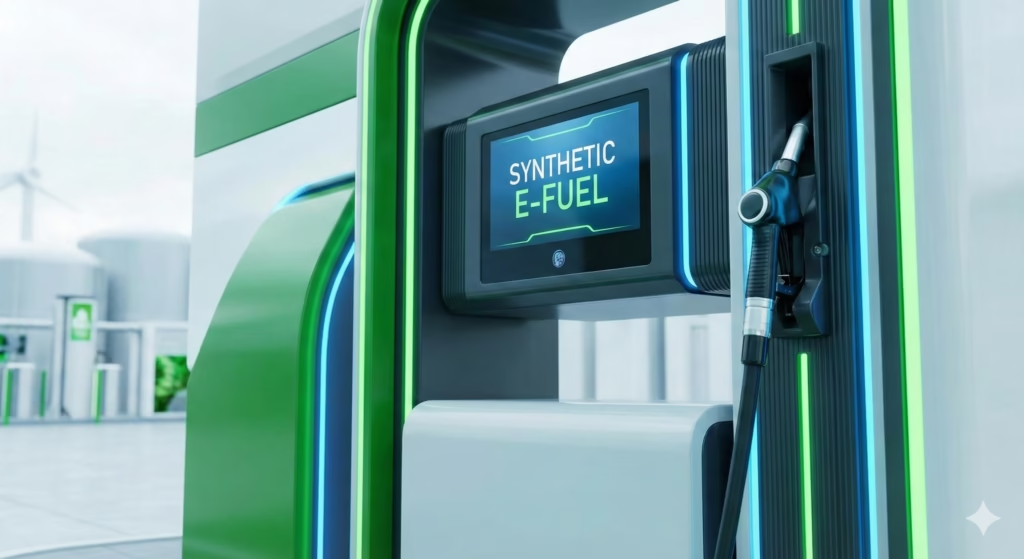
One of the most exciting developments keeping the combustion engine alive is the research into synthetic fuels, often called e-fuels. These are complex, man-made fuels created by capturing carbon dioxide from the atmosphere and combining it with green hydrogen.
Because the creation process removes carbon from the air, burning synthetic fuel in a traditional engine is theoretically carbon-neutral. If this technology can be scaled up and made affordable, it could allow classic cars and future high-performance vehicles to retain their combustion engines indefinitely without harming the environment.
Solid-State Batteries: The Next Frontier
For electric supercars to truly gain traction, battery technology must take a monumental leap forward. The industry is currently waiting for the commercialization of solid-state batteries.
Unlike current lithium-ion batteries that use a liquid electrolyte, solid-state batteries use a solid material. They promise to be drastically lighter, charge in a fraction of the time, and carry significantly more energy in a smaller physical footprint. Once solid-state batteries become viable, the weight penalty of EVs will vanish, potentially unlocking a new era of ultra-light, ultra-fast electric performance cars that finally appeal to the traditional enthusiast.
Final Thoughts
The automotive industry is in the middle of its most significant transformation in over a century. However, the path forward is proving to be far more nuanced than simply replacing gas tanks with battery packs. The luxury and high-performance sectors serve as a fascinating reminder that cars are not just appliances to everyone. For a dedicated segment of buyers, the mechanical heartbeat of a vehicle matters just as much as how fast it can go. Until electric vehicles can genuinely replicate or replace that emotional connection, the roaring engines of the world’s most exotic cars will continue to echo on our roads for years to come.