
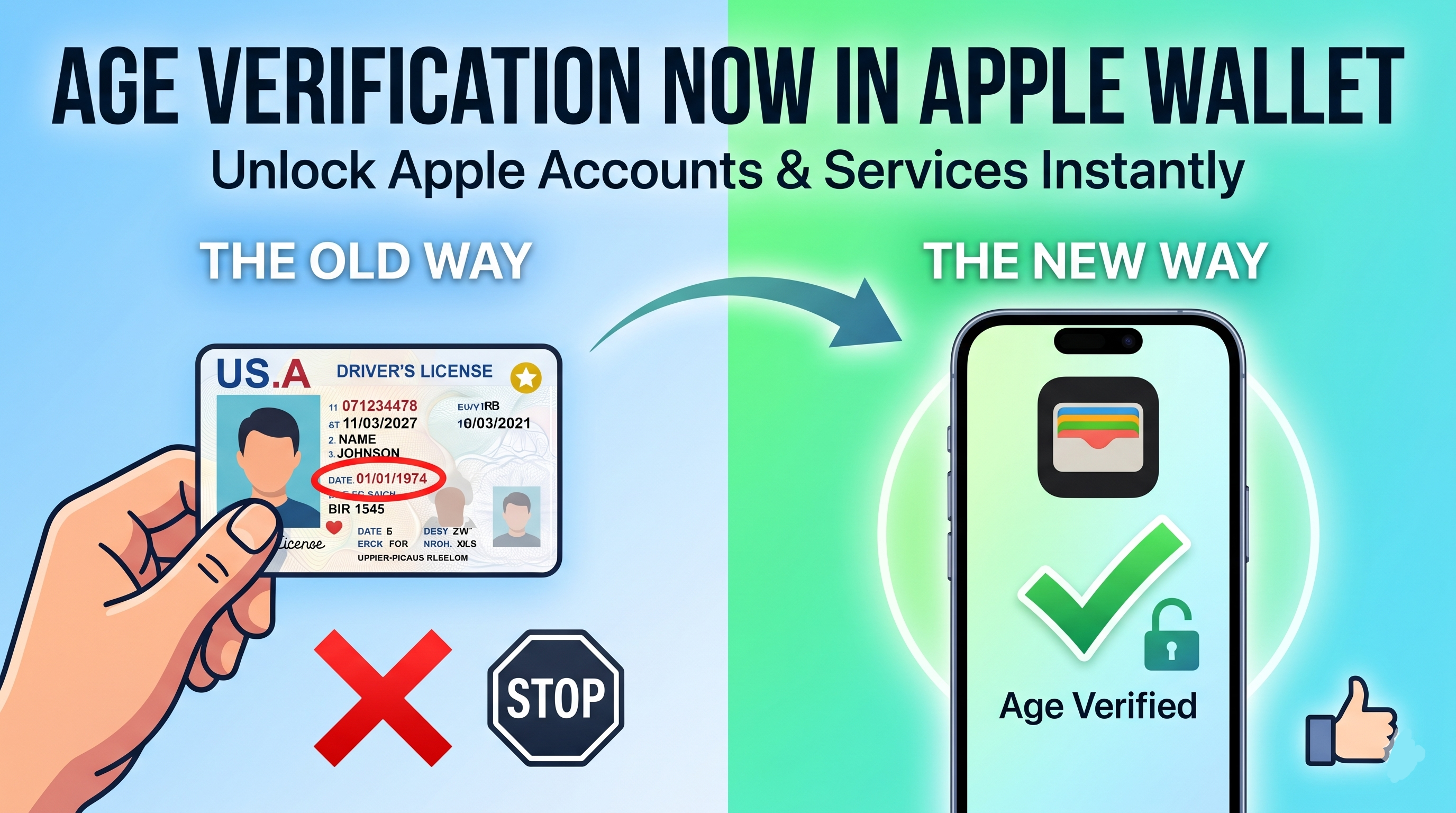

Start by thinking about your everyday routines. Most of us carry a smartphone everywhere we go, yet we still find ourselves digging through physical wallets to prove how old we are. Even more frustrating is the online experience. Have you ever tried to buy an age-restricted service, download a mature app, or set up a secure account, only to be prompted to upload a photo of your driver’s license to a random third-party website? It feels risky, tedious, and incredibly outdated.
The tech world has been actively moving toward a better solution, and recent developments highlight how apple wallets are stepping up to bridge this gap. There is a massive industry push to utilize the digital IDs stored on our smartphones for seamless age verification. Instead of handing over sensitive, unencrypted physical documents, users can now rely on their devices to silently and securely prove their age.
In this guide, we are going to explore how this technology actually works, why it is a major upgrade for our personal privacy, and what it looks like from a practical, everyday user standpoint.
The Shift from Physical to Digital Identity
To understand why this change is so important, we have to look back at how we have traditionally handled identity checks on the internet. For years, proving your age online relied on a simple honor system—typing in a random date of birth and clicking a box that said, “I am over 18.” When services realized this wasn’t protecting anyone, they swung to the opposite extreme. Platforms started demanding high-resolution photos of government-issued IDs to grant access to certain accounts.
From practical experience, handing over a picture of your passport or driver’s license to an app developer or an online service feels incredibly invasive. That single photograph contains your home address, exact date of birth, license number, and physical characteristics. If that company’s servers are ever breached, your entire identity is compromised.
This is exactly the problem that modern digital wallets aim to solve. Apple has spent the last few years quietly building the infrastructure for digital identification. They initially partnered with organizations like the Transportation Security Administration (TSA) to allow travelers to navigate airport security using just their iPhones. Now, that same highly secure foundation is being expanded to handle everyday age verification tasks directly within the device’s own ecosystem. The ultimate goal is simple: let you prove you are an adult without giving away the rest of your life’s details.
How Age Verification Works Within Apple Wallets
If you have ever set up Apple Pay to buy a coffee, you already understand the basic concept behind adding an identity card to your phone. However, the background mechanics of verifying your age are uniquely fascinating.
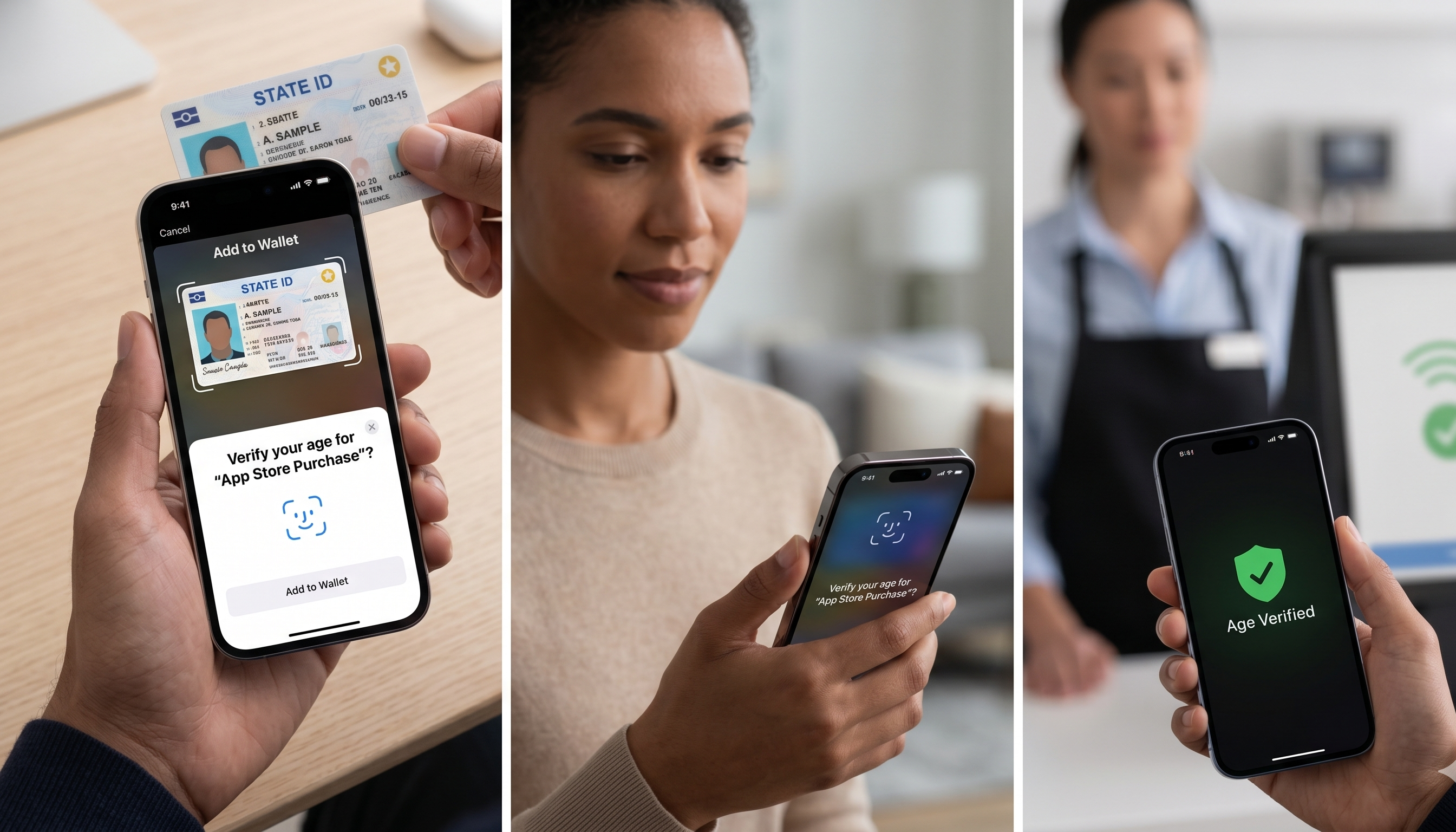
When you add a supported government ID—such as a state driver’s license or a U.S. passport—into your digital wallet, the physical card is scanned and securely encrypted directly onto the device. It is not just a standard photograph sitting in your camera roll; it is a mathematically verified cryptographic token locked securely behind your biometric data, like Face ID or Touch ID.
In real-world use, this makes the verification process incredibly smooth. Let’s say you are setting up a new Apple account, altering complex family safety settings, or trying to download an app with a strict 18+ rating. Instead of the system asking you to upload a photo of your ID to a remote server, a simple prompt will appear on your screen.
The system will essentially ask your device: “Is the owner of this phone over the required age?”
You double-click the side button, authenticate your face or fingerprint, and your phone sends a basic “Yes” or “No” securely back to the service. The app requesting your age never actually sees your birth date, your home address, or your driver’s license number. It only receives the verification that you meet the specific age requirement. This concept is known in the security industry as “data minimization”—giving out the absolute minimum amount of information necessary to complete a transaction.
Many users notice that this dramatically speeds up the process. Instead of waiting hours or days for a human moderator to manually review an uploaded ID photo, the entire authentication takes a fraction of a second.
Why This Matters for Everyday Users
You might be wondering how often you actually need to verify your age online. As digital regulations tighten around the world, the answer is: more frequently than you might think.
Governments and app stores are under increasing pressure to protect minors from explicit content, mature gaming applications, and certain online financial services. Historically, tech companies required developers to handle their own age checks, which led to a fragmented, frustrating, and often unsecure user experience.
By integrating age verification directly into apple wallets, the entire ecosystem becomes much safer and more cohesive. Consider a few practical everyday scenarios:
- Account Creation and Recovery: Establishing a new digital identity or recovering a locked account often requires strict proof of who you are. A quick Face ID scan linked to a digital passport streamlines this instantly.
- Parental Controls: Parents setting up family sharing and modifying content restrictions for their children can authorize these changes much more securely. It ensures that kids cannot easily bypass safety settings without the parent’s biometric approval.
- Purchasing Restricted Content: Whether it is buying an R-rated movie, a mature video game, or a subscription service requiring users to be legally recognized as adults, the checkout process is no longer bottlenecked by clunky, third-party ID verification steps.
From a user experience standpoint, the elimination of third-party verification websites is a massive relief. Nobody wants to be redirected to a web portal they have never heard of, forced to hold their driver’s license up to their laptop webcam, and wait for a green checkmark. By keeping the process local to the device, it feels like a natural, trustworthy extension of the phone itself.
Privacy First: Is Your Data Truly Safe?
Whenever we talk about digitizing government IDs, the conversation inevitably turns to privacy. It is perfectly natural to be skeptical. Why should we trust a global tech company with our most sensitive government documents?
The beauty of how apple wallets handle this data lies in the physical hardware architecture of modern smartphones. When you load your passport or state ID onto your phone, the sensitive data is not uploaded to a centralized cloud server where it can be hacked. Instead, it is stored locally in the “Secure Element” of your device. This is a dedicated, isolated computer chip designed specifically to hold cryptographic keys. It is the exact same chip that keeps your credit card data completely safe when you tap to pay at a grocery store.
Furthermore, Apple itself does not have access to your digital ID. They cannot see when or where you are presenting your ID, and they do not keep a running log of the apps you have verified your age for. When you use the system for age verification, the transaction is strictly between your device and the app requesting the information.
Many tech professionals argue that this digital method is actually far safer than carrying a physical wallet. If you drop your physical wallet on the street, anyone who picks it up has instant access to your name, address, and date of birth. If you lose your smartphone, your digital ID remains locked behind your biometric data and passcode, making it virtually impossible for a stranger to access or misuse your identity.
Overcoming the Challenges of Broad Adoption
While the technology is undeniably impressive, we are still in the early stages of a broader transition. Right now, the usability of this feature is somewhat limited. Much of the functionality is currently exclusive to specific regions—most notably within the United States—and is primarily tailored to Apple’s own services and accounts.
However, from what we have seen with digital payments over the last decade, adoption tends to snowball. Ten years ago, tapping your phone to pay for a meal felt futuristic; today, it is the absolute standard. The same trajectory is highly likely for digital identification.
As state governments continue to modernize their motor vehicle departments and issue official digital credentials, we can expect the use cases to expand rapidly. Soon, using your smartphone for age verification won’t just be for downloading mature apps or updating account settings. It could easily expand to buying age-restricted items at self-checkout kiosks, entering age-restricted venues, or verifying your identity for online banking—all without ever revealing your actual date of birth to a cashier or clerk.
Preparing for a Passwordless, ID-Free Future
As we look toward the future of technology, the line between our physical identities and our digital lives is rapidly blurring. The integration of official government documents into our smartphones represents a massive leap forward in both convenience and everyday security.
For years, we have simply accepted that proving our age online meant sacrificing a piece of our personal privacy. We traded our personal data for access to services because we had no other choice. The evolution of apple wallets is proving that this trade-off is no longer necessary. By utilizing advanced encryption and biometric authentication, we can finally achieve a system where security and convenience coexist beautifully.
The next time you are prompted to verify your identity online, you might not have to reach into your back pocket for a piece of plastic. Instead, a simple glance at your phone screen will be all it takes to securely, privately, and instantly prove exactly who you are. This isn’t just a minor software update; it is a fundamental shift in how we will manage our personal identities in the modern digital age.